
Articles -> Disability Visibility
There is a specific kind of exhaustion that comes from looking too closely at the gears of my own mind. Like trying to catch the water of a rushing river, it is an exercise in futility. On my more challenging days, I ask myself, “Is it really easier just to let go and surrender to the flow? Especially when I am already treading water?”
Allow me to explain this extended metaphor. As someone living with autism and a concurrent mood disorder, my daily experience is often a hyper-vigilant exercise in minutiae. If I dial in on the individual components of any given day, the landscape quickly begins to dissolve and my mind turns into a tunnel-vision critic, saying “Oh, I shouldn’t think that way,” or “I don’t like how that interaction went. It should have gone something like this.”
Zooming in on the individual rocks and sharp edges of a single social exchange or a sudden shift in mood feels less like self-awareness and more like drowning in detail. That defeats the entire purpose of self-reflection!
Lately, however, I’ve found peace in a different perspective. Neurodiversity, I’ve realized, is very much like sitting on the banks of the mind-river and observing its flow.
If I fixate entirely on a single aspect of the river–jagged rocks disrupting the current, unpredictable darting of the creatures beneath the surface, or debris caught in an eddy–the water starts to look chaotic. It becomes an overwhelming, dizzying collection of moving parts that feels impossible to track or control.
Alternatively, if I step back and look at the river as a single, functioning whole, the entire experience changes. I realize that despite the obstacles, the river is doing exactly what it is meant to do: It is flowing. In that broader view, the chaos recedes, replaced by something unique, serene, and profoundly beautiful: radical self-acceptance.
For a long time, I only knew how to look at the rocks. I spent so much energy trying to smooth over the rough patches of my autism or tightly control the dips in my mood. However, you cannot alter the geology of a riverbed while standing in the middle of a rushing current. You can certainly tire yourself out trying!
When I stop dissecting the microscopic friction of masking or trying to perfectly calibrate a chipper tone of voice, I can see the larger, more authentic picture. My life is actually quite fulfilling, vibrant, and harmonious. It is not harmonious because it is a perfect still life. It is harmonious because it is dynamic and rushing, just like everything else that surrounds it. The deep sensitivities and emotional peaks and valleys aren’t separate flaws to be smoothed over. They are simply the currents and contours that shape my unique river on life’s moving landscape.
My advice? Do not look at your river and demand it remove its rocks or quiet its wildlife to make its passage simpler. Accept the ecosystem as a whole. By allowing ourselves to stop over-analyzing the minutiae of our lived experiences, we can finally appreciate the grace of our own momentum. We aren’t a collection of symptoms or social missteps to be corrected. We are a whole, functioning, and beautiful river, finding its own special path to the sea.
That, I have learned, is the key to not drowning in this complexity we call life. When the water gets choppy and the urge to micro-analyze creeps back in, I am learning to simply step back to the bank, watch the whole, and breathe. I encourage you to do the same. Treat this metaphor as something of a meditation, if that helps. Why suffer with stress when you can truly surrender to the flow?
About the Author
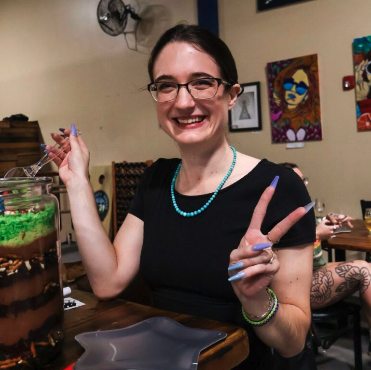
Caitlin (s/he/they) is an activist, artist, author, and radio DJ based in Middletown, CT, where she spent much of her early life in local arts and community spaces. Through her experiences, Caitlin developed a strong connection to the local arts community and an awareness of the barriers many people face.